
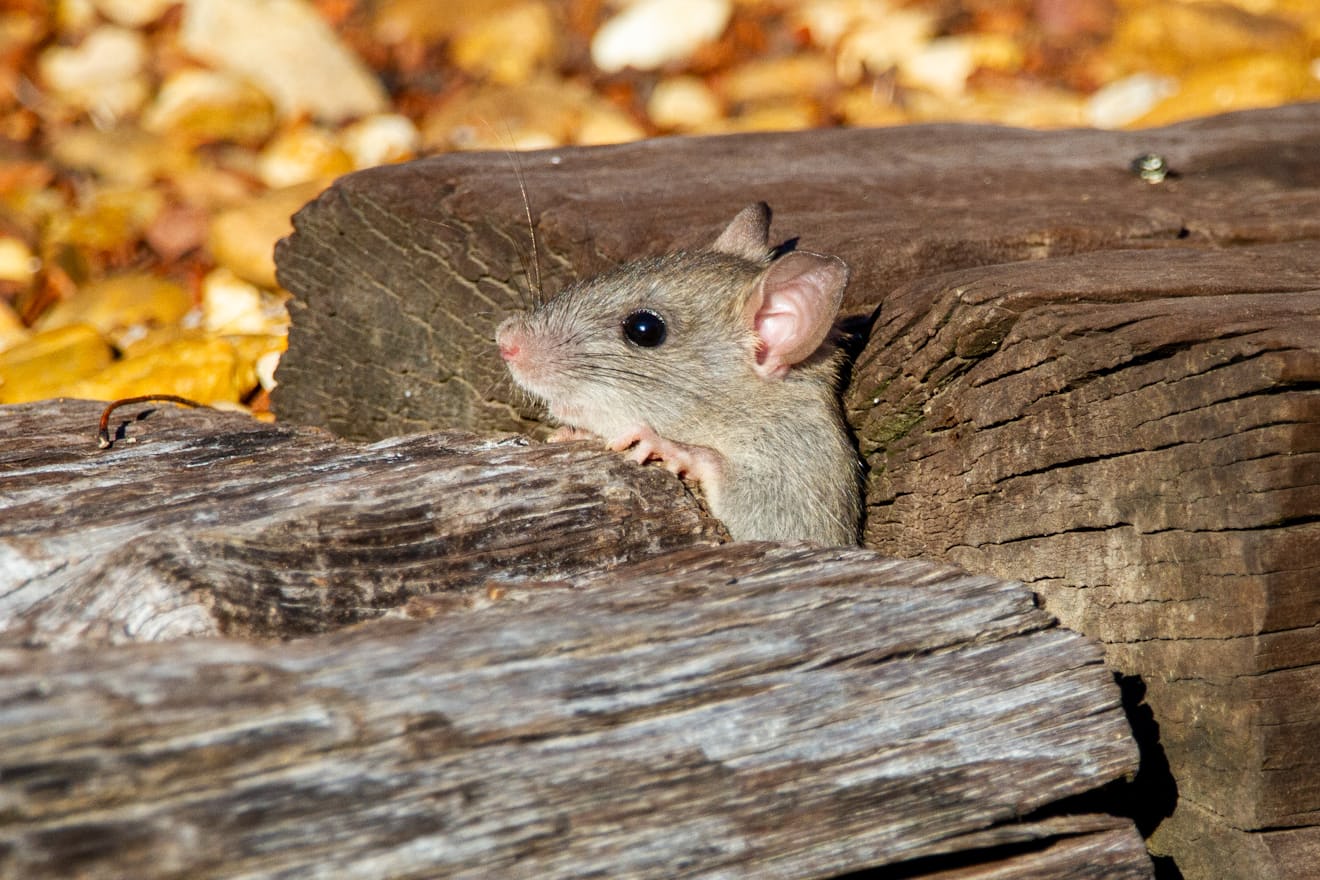
Rodent control in Charlotte, NC starts with naming the animal
Rodent control in Charlotte covers three animals that get treated as one problem and are not the same: the roof rat, the Norway rat, and the house mouse. They live in different parts of a building, travel different distances, fit through different sized gaps, and respond to different trap spacing and bait. Get the identification wrong and the work underperforms no matter how much effort goes into it.
This page is the identification reference. If you already know what you have, go straight to rat removal or, for a spread population, infestation treatment.
Roof rat (Rattus rattus)
The climber, and the most common cause of Charlotte attic calls. A roof rat is slimmer than most people expect, six to eight inches of body with a tail longer than the body, large thin ears, a pointed nose, and a dark grey to black coat. It is an outstanding climber and a poor digger.
- Where it lives: attic insulation, upper wall voids, the space above a kitchen soffit, and outdoors in dense ivy, palms, and tree canopy.
- How it gets in: willow oak and maple limbs touching the roof, fence tops, trellises, downspouts, and utility drops, then soffit returns, gable vents, and roof-to-wall seams.
- Droppings: about half an inch, spindle shaped with pointed ends, usually found on joists and along runways rather than in a pile.
- Sound: fast scurrying overhead after dusk and before dawn, with dragging noises as nest material moves.
- Feeding: leans toward fruit, nuts, seeds, and plant material, which is why bird feeders and fruit trees matter here.
Roof rats are why the older tree-heavy neighborhoods, Dilworth, Myers Park, Elizabeth, Eastover, Cotswold, and Sedgefield, generate so much attic work. Details in attic rat control and cleanup.
Norway rat (Rattus norvegicus)
The burrower. Heavier and stockier, seven to ten inches of body with a tail shorter than the body, small ears, a blunt nose, and coarse brown fur. It digs well and climbs poorly by comparison, so it lives low.
- Where it lives: burrows along foundations, under decks, sheds, and concrete slabs, in storm drains and sewers, and along creek banks.
- How it gets in: crawl space vents, rotted access doors, sill plate gaps, pipe penetrations, garage door corners, and floor drains.
- Droppings: three quarters of an inch, capsule shaped with blunt ends, often concentrated near a burrow entry or a food source.
- Sound: under the floor rather than overhead, with gnawing and scratching in a crawl space or utility room.
- Feeding: leans toward protein, grain, and garbage, which ties it to dumpsters, compost, and pet food.
Charlotte's creek corridors, Little Sugar Creek, Briar Creek, Irwin Creek, McAlpine Creek, and Mallard Creek, carry resident Norway rat populations, and the greenways along them are continuous travel lanes with water, cover, and food. Properties backing those corridors need grade-level exclusion as ongoing maintenance rather than a one-time repair.
House mouse (Mus musculus)
Small, light, and quick. Two and a half to four inches of body, under an ounce, with a thin tail roughly as long as the body, a pointed nose, and light brown to grey fur.
- Where it lives: wall voids, cabinet bases, behind and under appliances, inside stored boxes, in drawer backs, and in insulation close to a food source.
- How it gets in: a gap the width of a pencil, roughly a quarter inch. Utility penetrations, garage door corners, dryer vents, and gaps behind trim.
- Droppings: three to six millimetres, dark, rice-grain shaped, scattered widely rather than in runs.
- Sound: light scratching and gnawing, often inside a wall at cabinet height rather than overhead.
- Range: a mouse lives its whole life within a small radius of the nest, sometimes ten to thirty feet. Rats range much further.
Why the difference changes the work: mouse traps go a few feet apart because the animal never travels far. Rat traps go on long established runways. Exclusion sized for rats leaves mouse-sized gaps wide open. Setting the wrong plan means catching a few animals and then wondering why the noise continues.
The quick field test
- Measure a dropping. Rice grain means mouse. Coffee bean or larger means rat. Pointed ends lean roof rat, blunt ends lean Norway rat.
- Note the height. Attic and upper walls lean roof rat. Crawl space, garage, and floor level lean Norway rat. Kitchen cabinet height leans mouse.
- Note the time. After dusk and before dawn means rats or mice. Midday means squirrel.
- Note the weight of the sound. Audible thumping and dragging means rat. Faint scratching means mouse.
- Look for grease trails. A dark rub line along a joist or pipe is a rat signature. Mice leave much fainter marks.
What Charlotte conditions mean for all three
Winters here are mild, with short freezes rather than sustained cold, so none of these three gets a population reset over the cold months. They simply move indoors and keep breeding. Hot, humid summers push activity toward water and shade, which means crawl spaces and the shaded side of a building. Housing stock splits the entry pattern: brick-pier crawl spaces and balloon framing in the older ring, slab construction with weep holes and garage corners farther out.
All of which means the same conclusion. Identify the animal, then match the work to it. For the health side of any rodent problem, the CDC rodent page is the plainest reference available.
Not sure what you have? Describe it
Say where the droppings are and roughly how big, where the noise is and what time it happens, and whether you have seen anything. That is usually enough to name the animal before anyone arrives. Rodent work runs across Charlotte and Mecklenburg County, including Matthews, Mint Hill, Cornelius, and Davidson.